The Senior Living Month-End Close Calendar: A Day-by-Day Path for Multi-Community Operators
By Luke Chirayil · October 14, 2026

With a dozen communities, every manual handoff between your resident, billing, payroll, and accounting systems comes due in the same week. In our experience, your controller spends much of the close reconciling across disconnected systems.
A close calendar fixes the order of the work. Each day finishes the layer the next day depends on, so nobody applies cash against billing that is still moving. Flow Digital works with senior living operators on these system handoffs, and the calendar below is the sequence we would give a controller closing several communities at once. It aims for five to seven business days.
Why the sequence matters
Consider billing that gets finalized after the AR aging has already been pulled, or intercompany eliminations that run before every community has submitted its entries. In both cases the earlier work has to be redone.
Putting revenue and census first gives everything downstream a stable base. Cash, payables, payroll, and the ledger follow, then consolidation and review.
The calendar
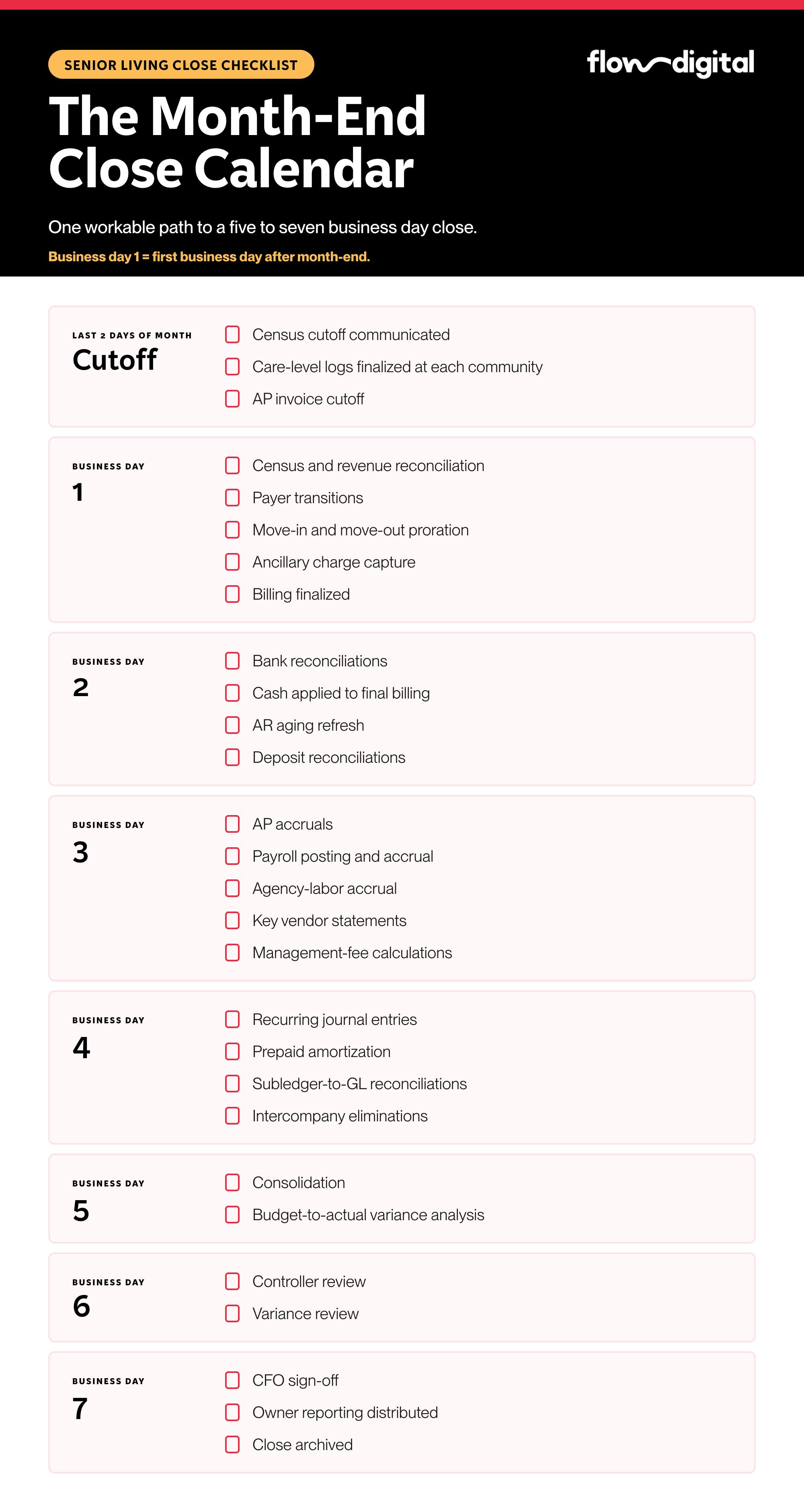
Business days -2 to -1: set the cutoffs
A close that waits for the month to end is already behind. Every community needs to know the census cutoff, the AP invoice cutoff, and when the care-level and acuity change log is due. A community that submits its move-in log late on day one holds up the whole portfolio.
By the end of this window, each community's care-level log is finalized and signed off. Finance needs the care level and the effective date from each log. Once the cutoffs pass, the billing period locks.
Business day 1: census and revenue
Business day 1 is the first business day after month-end. Revenue comes first because most of the later work depends on it. This is the day to tie census from your care system to billed census to GL occupancy for each community, and to resolve the variances.
It is also the day for the senior-living-specific tie-outs: care-level changes posted to the billed rate on the effective date, move-ins billed from the move-in date, move-outs prorated and stopped, ancillary charges captured, and residents whose payer changed during the month re-billed correctly. Billing is finalized at the end of the day, which is the target; a large portfolio may need more time.
Business day 2: cash and receivables
Cash gets applied cleanly only against billing that has stopped moving, which is why this day follows billing. Bank reconciliations tie to GL cash, and autopay and ACH batch postings and lockbox deposits get applied against final billing, so the AR aging reflects what residents owe. Refresh the private-pay AR aging by community, review anything over 90 days, and reconcile resident deposit balances the same day.
Business day 3: payables, payroll, agency labor, and management fees
Expenses get brought into line on this day: vendor invoices, accruals for goods and services received but not yet billed, payroll posting, and statements from your recurring vendors (food service, medical supplies, utilities). Agency and contract labor gets accrued against the hours worked, then reconciled to the hours the agency billed. Management fees get calculated under each management agreement once revenue is final, so they are on the books before intercompany eliminations run on day 4.
Business day 4: the ledger
The ledger gets proved on this day. Recurring journal entries post, prepaids amortize, and every balance-sheet subledger gets reconciled to the GL. Intercompany transactions are recorded and eliminated on this day, once each community's entries are in.
Business day 5: consolidation and the owner view
Owners and investors judge the portfolio on the consolidated view. Community profit and loss statements consolidate into the portfolio or ownership entity. The budget-to-actual analysis begins, with a short written narrative for each community.
Business days 6 and 7: review and release
Nothing goes to owners before review. The controller reviews each community package and every subledger reconciliation on day 6, then reviews variances against the prior month and the budget. Outliers need an explanation before anyone above the controller sees the numbers.
Day 7 belongs to the CFO or VP Finance for sign-off. Reporting goes out to owners and investors as aggregate results with no resident-level data, and the close binder and reconciliations get archived for audit.
Where this calendar usually breaks
In our experience, the close most often stalls at the reconciliation steps in revenue and census, payroll and labor, and the general ledger, which land on days 1, 3, and 4. Day 1 slips when census, billing, and the care-level log disagree and a person has to work out which one is right.
The cause is the same across those steps. The resident system knows what care was delivered while the billing system never hears about it, so a spreadsheet and a person's memory sit in between. Connecting the two systems reduces the manual reconciliation that stretches the close.
Adjusting the calendar for your portfolio
Treat the day assignments as a starting point. A management company closing for several owners may need to move the owner packages earlier for the ownership groups with tighter reporting deadlines.
Closing several communities and want a second set of eyes on your calendar?
We will walk through your systems and your close together.

Luke Chirayil
Luke Chirayil is Flow Digital's Full Stack Developer and API Specialist. Based in Chicago, he's been building automations since 2018, drawing on a coding background to create custom solutions when off-the-shelf tools fall short. Luke specializes in the integrations that connect the systems businesses actually run on.


Let's make your workflow woes a distant memory.